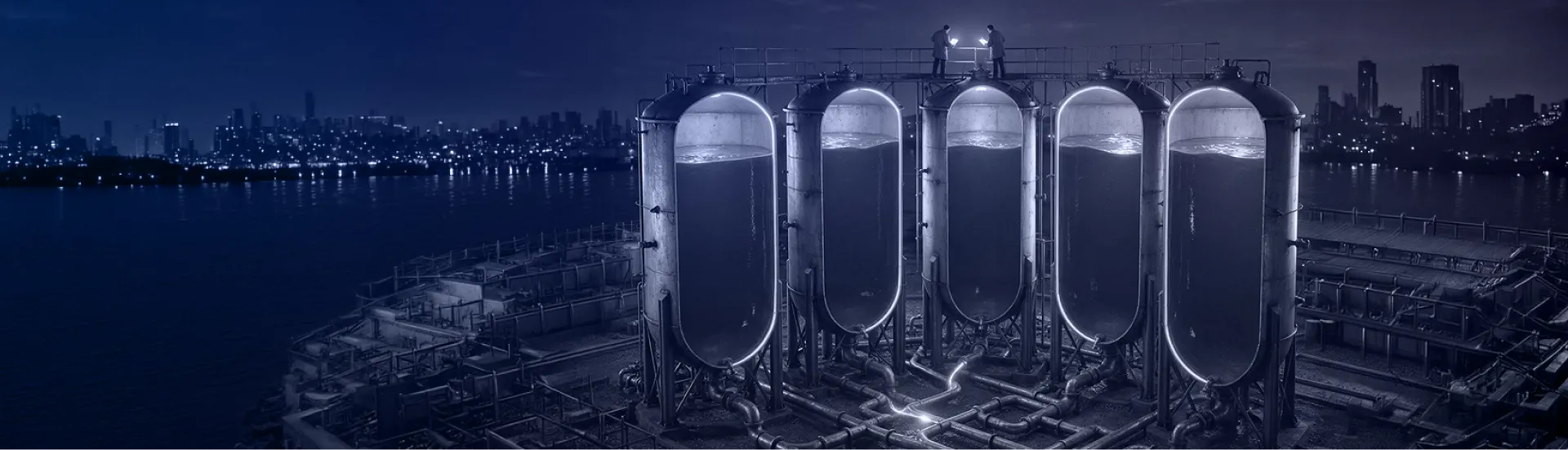
Bayonne, New Jersey, early 1960s. A trader named Tino De Angelis has a yard full of giant tanks of soybean oil, and he uses them as collateral to borrow. The inspectors show up, measure, and sign off. The tanks are full.
They weren't. Oil floats on water, and most of the tanks were water with a thin layer of oil on top. The tanks were connected by pipes, so as the inspectors walked from one to the next, the same oil was pumped ahead into the tank they were about to measure. And the dipstick, the one that went down to the bottom and came up soaked in oil, actually dropped into a tube full of oil installed in the middle of a tank of water.
When it all came apart in November 1963, dozens of companies had lent against oil that didn't exist. It went down in history as the Great Salad Oil Swindle.
Paul Burke told us the story on All You Can Debt. Paul has been a lawyer, an investment banker, a financial guarantor, a commercial banker, and a consultant; he has structured deals in Mexico, Asia, and Europe, and he describes himself as an upstanding securitization citizen. He learned the case in law school, and he tells it for a precise reason: commercial fraud is as old as commerce, and it has barely changed.
Sixty years, the same three tricks
Put Bayonne next to Tricolor, the subprime auto lender that went bankrupt in September 2025.
The water under the oil is inflated collateral. According to the federal indictment, Tricolor had pledged about $2.2 billion in assets when its own records showed roughly $1.4 billion in real collateral.
The pipes between tanks are the double pledge. According to the post-bankruptcy review, some 29,000 of its roughly 70,000 active loans shared a vehicle identification number with another loan already pledged. The same car, shown in two tanks.
And the dipstick with the tube of oil is the perfect sample. The indictment describes a fictitious portfolio company created in Tricolor's system so that loans already charged off would look like healthy ones. What the lender measured was flawless. What surrounded it was not.
Neither the oil nor the cars matter. The three tricks are the same because all three exploit the same weakness: whoever verifies looks at what the borrower puts in front of them.
The inspectors did show up
There's one detail from the 1963 case that says it all: the company issuing the warehouse receipts let De Angelis himself pick the custodians for the tanks. The inspection existed. What didn't exist was independence.
That's the pattern that keeps repeating. Tricolor had a trustee and a backup servicer, but no one was playing the role of verification agent, because no lender had asked for it. Valentina, our CEO, put it this way in the conversation: what are you going to service if you never verified anything? When it all blows up, someone has to rebuild the information from scratch, exactly when it's no longer useful.
And the pipe trick has one condition: it only works if each inspector looks at nothing but their own tank. In Latin America, verifiers integrate even with their competitors to confirm they aren't looking at the same asset twice. In the United States, one servicer doesn't connect to another. Paul put it bluntly: that is at the heart of the Tricolor problem.
Who gets someone to watch every tank
For Paul, the solution runs through an independent registry. He doesn't believe Congress will legislate it, so he sees two paths: a consortium of the largest lenders building a central utility, or a few lenders adopting verification first and the fraud moving to those without it, like the first kid on the block with something everyone else soon wants.
That leaves the uncomfortable question of incentives. Trustees earn pennies for work that is more administrative than operational, and lenders fear losing the deal if they ask for data access. When will the market care? When it hits their wallet, whether through a systemic crisis or because the retail money so many want to bring into private credit forces regulators to ask the questions no one asks today.
At Vaas, we don't wait for that moment. We verify the existence, ownership, and cash flows of every asset against the source, every day, and independently of the borrower. In other words, we look at the bottom of the tank, not at the dipstick.
Fraud was never creative. What was missing was someone watching.
The full conversation with Paul Burke, including how a structure born in Latin America ended up financing pubs in London and donut franchises in the United States, is on the episode of All You Can Debt.
⏯️ YouTube 👉 https://shorturl.at/FnP9c
🎧 Spotify 👉 https://shorturl.at/EsUaV
How Vaas verifies the asset is actually there: https://getvaas.com


